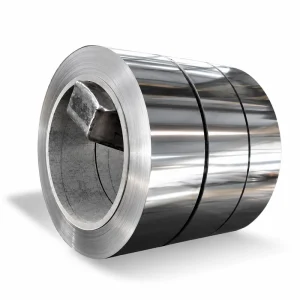
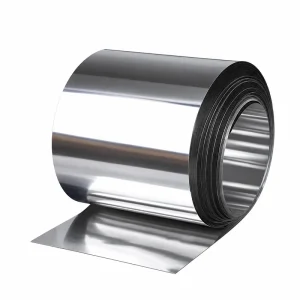
416 Stainless Steel Coil
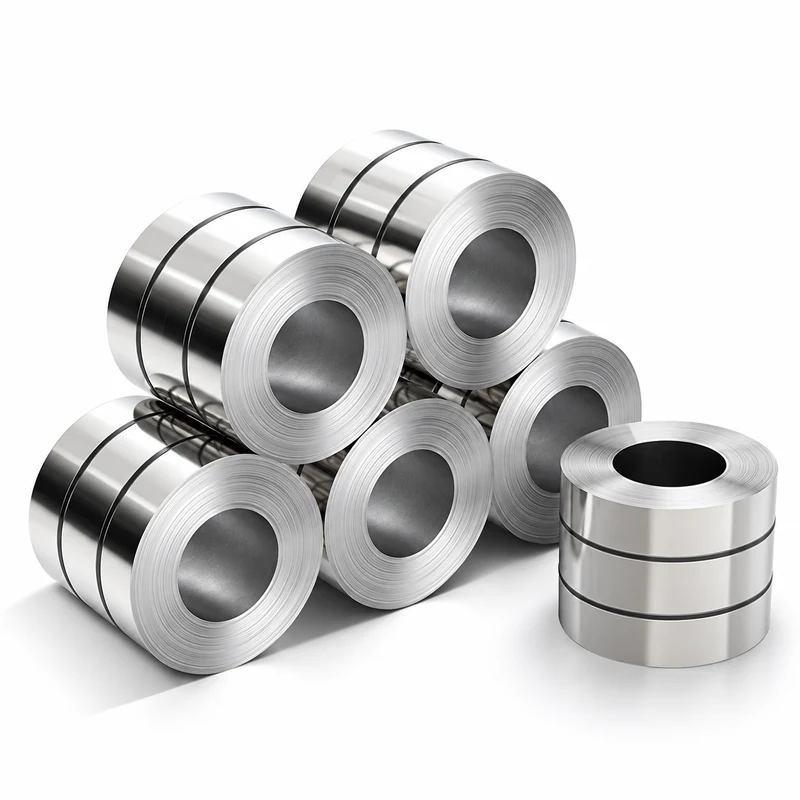
416 Stainless Steel Coil
416 Stainless Steel Coil (UNS S41600) is a free-machining martensitic stainless steel containing 12.0–14.0% chromium and added sulfur for improved machinability. It can be hardened through heat treatment and is suited to producing machined shafts, threaded components, and precision hardware, subject to material form and processing requirements.
- Mill Test Certificate Provided
- Strict Quality Inspection
- Custom Sizes Available
- On-Time Global Delivery
416 Stainless Steel Coil (UNS S41600) is a free-machining martensitic stainless steel containing 12.0–14.0% chromium and a minimum of 0.15% sulfur. The sulfur addition improves chip breaking and machinability compared with conventional martensitic grades such as 410, although it reduces corrosion resistance, weldability, and forming performance.
Grade 416 can be hardened and tempered to achieve specified mechanical properties. Where available in coil or strip form, the material may be slit or cut into blanks for subsequent machining and component production. Its delivery condition, dimensional tolerances, and processing suitability should be confirmed before ordering.
Typical applications include machined shafts, threaded components, valve parts, and precision industrial hardware. These products are more commonly manufactured from 416 stainless steel bars. Coil availability should therefore be verified with the supplier, particularly for custom thicknesses, widths, and surface finishes.
Product Features
- Free-Machining Martensitic Structure – Grade 416 contains added sulfur to improve chip breaking and cutting performance compared with conventional martensitic stainless steels such as Grade 410.
- 12.0–14.0% Chromium Composition – Provides moderate corrosion resistance in mild environments, although sulfur additions reduce resistance to localized corrosion.
- Heat-Treatable Mechanical Properties – Can be hardened and tempered to achieve specified hardness and mechanical strength for precision-machined industrial components.
- Improved Machining Efficiency – Suitable for turning, drilling, threading, and other machining operations requiring controlled chip formation and efficient material removal.
- Precision Industrial Components – Commonly used for machined shafts, threaded parts, valve components, and industrial hardware, primarily manufactured from bar stock.
- Custom Coil & Strip Processing – Where available, coil material can be slit or cut to specified dimensions, subject to confirmed thickness, width, surface finish, and delivery condition.
Technical Specifications
| Parameter | Specification |
|---|---|
| Product Name | 416 Stainless Steel Coil |
| Material Grade | AISI 416 / Type 416 |
| UNS Designation | S41600 |
| Material Standard | Applicable specification to be confirmed; ASTM A582/A582M commonly covers free-machining stainless steel bars |
| Stainless Steel Type | Free-Machining Martensitic Stainless Steel |
| Chromium (Cr) | 12.00–14.00% |
| Carbon (C) | ≤ 0.15% |
| Manganese (Mn) | ≤ 1.25% |
| Silicon (Si) | ≤ 1.00% |
| Phosphorus (P) | ≤ 0.060% |
| Sulfur (S) | ≥ 0.15% |
| Nickel (Ni) | ≤ 0.75% |
| Rolling Process | Cold Rolled / Hot Rolled, subject to supplier confirmation |
| Delivery Condition | Annealed or other agreed condition, subject to availability |
| Surface Finish | Subject to supplier confirmation |
| Thickness | Custom thickness, subject to manufacturing availability |
| Coil Width | Subject to supplier availability and slitting capability |
| Edge Condition | Mill Edge / Slit Edge, where available |
| Heat Treatment | Hardenable by quenching and tempering |
| Applications | Machined Shafts, Threaded Components, Valve Parts, Precision Industrial Hardware |
Applications
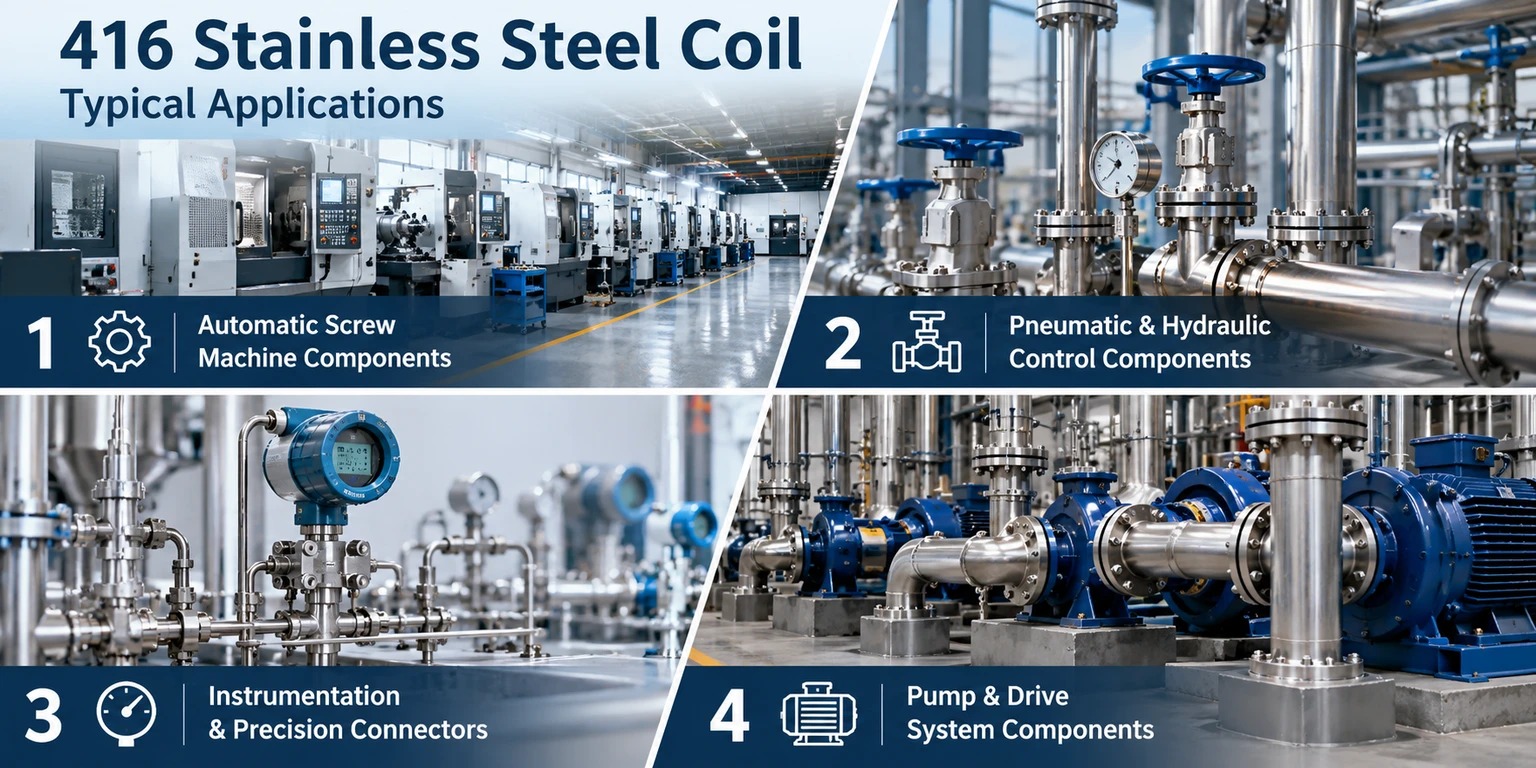
1. Automatic Screw Machine Components
416 stainless steel is widely used for precision components produced on automatic screw machines and CNC lathes. Its sulfur-enhanced machinability improves chip control during high-volume manufacturing. Typical parts include machined pins, threaded connectors, and small mechanical components requiring accurate dimensions and efficient cutting performance.
2. Pneumatic & Hydraulic Control Components
Grade 416 is used for selected valve stems, actuator parts, and precision fittings in pneumatic and hydraulic control equipment. Its free-machining properties support accurate threading and complex machining operations. Material selection should account for operating pressure, fluid compatibility, and corrosion exposure.
3. Instrumentation & Precision Connectors
416 stainless steel is used to manufacture selected instrument fittings, threaded connectors, and precision hardware. Its machinability supports consistent dimensional accuracy and repeatable production. Components exposed to moisture, chemicals, or corrosive environments require careful evaluation of material compatibility and surface protection.
4. Pump & Drive System Components
Grade 416 is used for selected pump shafts, drive components, and machined mechanical parts. Hardening and tempering can provide the required mechanical properties for specific applications. Material suitability depends on operating loads, wear conditions, fluid exposure, and the required surface finish.
Frequently Asked Questions
1. What is the difference between 416 and 410 stainless steel?
Both grades are martensitic stainless steels, but they serve different manufacturing needs. Grade 416 contains added sulfur to improve machinability, making it suitable for high-volume turning, drilling, and threading. Grade 410 generally offers better corrosion resistance, weldability, and forming performance. For precision-machined parts, 416 is often preferred; for components requiring welding or forming, 410 may be a better choice.
2. Why does 416 stainless steel have better machinability?
Grade 416 contains at least 0.15% sulfur, which promotes manganese sulfide (MnS) inclusions within the steel. These inclusions help chips break more easily during cutting, improving chip control and machining efficiency. This makes 416 suitable for automatic screw machines and CNC turning operations. Actual machining performance also depends on material condition, cutting tools, and machining parameters.
3. Can 416 stainless steel be hardened by heat treatment?
Yes. Grade 416 can be hardened through austenitizing, quenching, and tempering. The resulting hardness and strength depend on the heat treatment cycle, section thickness, and delivery condition. For components requiring specific mechanical properties, buyers should define the required hardness range and heat treatment condition before ordering.
4. Is 416 stainless steel suitable for stamping and bending?
Grade 416 is designed primarily for machining rather than extensive forming. Its sulfur additions reduce ductility and increase the risk of cracking during bending or stamping. Limited forming may be possible under suitable processing conditions. For applications involving substantial bending or deep drawing, grades such as 410 or 430 may be considered, depending on forming requirements, mechanical properties, and service conditions.
5. How corrosion resistant is 416 stainless steel?
Grade 416 provides moderate corrosion resistance in mild atmospheric environments but generally performs less well than 410 due to its sulfur-containing inclusions. It is not recommended for seawater service or aggressive chloride environments. Surface finish, heat treatment, moisture exposure, and operating temperature should be considered when evaluating its suitability.
6. What should buyers check before ordering 416 stainless steel coil?
First, confirm that 416 is available in coil or strip form, as this grade is more commonly supplied as bars. Buyers should then specify the required thickness, width, surface finish, edge condition, delivery condition, quantity, and dimensional tolerances. The applicable material specification, chemical composition, and material test certificate (MTC) should also be confirmed with the supplier before placing an order.