Black Welded Round Steel Pipe
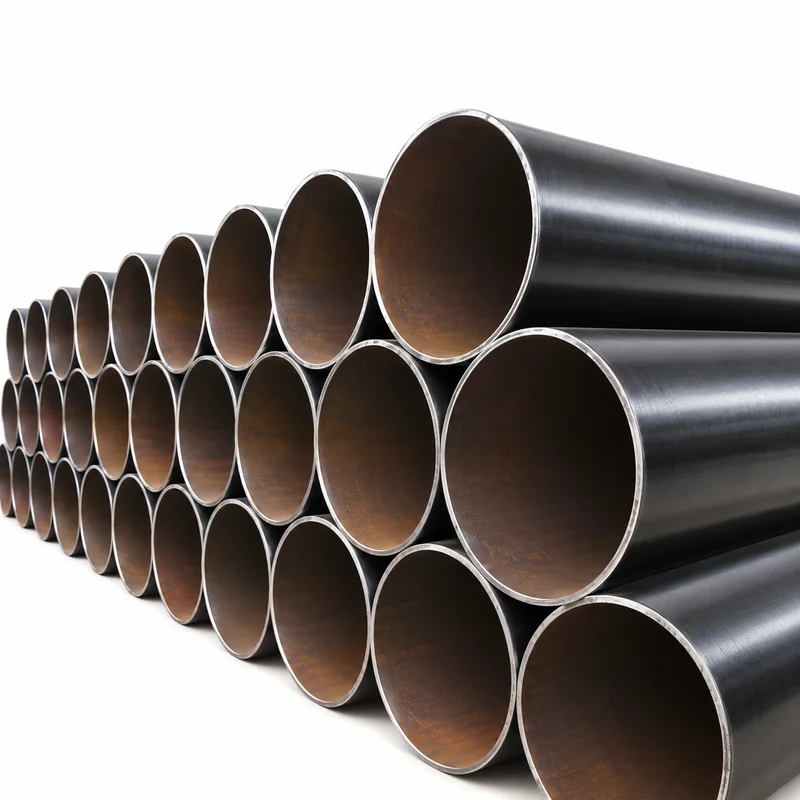
Black Welded Round Steel Pipe
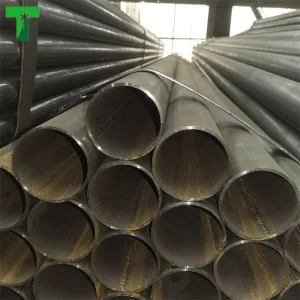
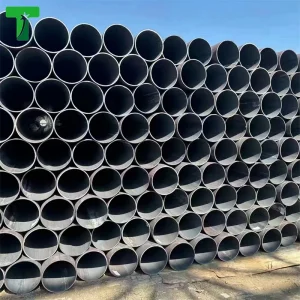
Black Welded Round Steel Pipe is manufactured from carbon steel using an electric resistance welding (ERW) process, with a circular cross-section and an uncoated black surface. Available in various outside diameters, wall thicknesses, and lengths, it is widely supplied for structural supports, mechanical fabrication, fencing, and general construction projects.
- Mill Test Certificate Provided
- Strict Quality Inspection
- Custom Sizes Available
- On-Time Global Delivery
The longitudinal weld seam is a critical part of black welded round steel pipe production. Consistent strip edge preparation, welding conditions, and sizing help maintain the integrity of the welded joint and the finished pipe geometry. During inspection, particular attention is given to weld continuity, outside diameter, ovality, and straightness, as these factors can affect subsequent cutting, fitting, and assembly.
ASTM A53, ASTM A500, and EN 10219 are commonly specified for welded steel pipes and structural hollow sections, but they are not interchangeable. ASTM A53 covers pipe intended for mechanical and pressure applications, while ASTM A500 and EN 10219 address structural carbon steel tubing under their respective requirements. Steel grades, dimensional tolerances, testing methods, and certification requirements should be established according to the intended service conditions.
For export orders, pipe ends may be supplied plain or prepared for further processing, depending on the agreed specification. When purchasing carbon steel pipe, buyers should distinguish between products ordered by nominal pipe size and those specified by actual outside diameter and wall thickness. Confirming the dimensional system, applicable standard, and inspection documentation before production helps avoid discrepancies when materials arrive at the project site.
Product Features
- Consistent Wall Profile: A uniform wall profile helps maintain predictable fit-up when pipes are joined with sleeves, brackets, or other fabricated components.
- Convenient End Preparation: Pipe ends can be prepared for beveling, threading, or other connection methods when the selected dimensions and specifications permit.
- Suitable for Bending and Forming: Appropriate material grades and wall thicknesses allow further bending or forming, with bend radius and tooling selected to limit distortion.
- Compatible with Common Joining Methods: Round pipes can be incorporated into welded, flanged, or mechanically connected assemblies, provided the connection design matches the pipe specification.
- Flexible Surface Treatment Options: The untreated surface allows subsequent painting or protective coating after suitable cleaning and surface preparation.
Technical Specifications
| Specification | Specification |
|---|---|
| Product Name | Black Welded Round Steel Pipe |
| Material | Carbon Steel |
| Steel Grade | Q195, Q235, Q355, ASTM A53 Grade A/B, ASTM A500 Grade B/C, S235JRH, S355J2H |
| Standard | ASTM A53, ASTM A500, EN 10219, GB/T 3091, GB/T 6728 |
| Manufacturing Process | Electric Resistance Welded (ERW) |
| Section Shape | Round |
| Outside Diameter | 21.3–406.4 mm (Reference Range) |
| Wall Thickness | 1.2–12.0 mm (Reference Range) |
| Length | 5.8 m, 6 m, 11.8 m, 12 m or Cut to Length |
| Surface Finish | Black / Non-Galvanized |
| Pipe Ends | Plain Ends, Beveled Ends or Threaded Ends (Where Applicable) |
| Further Processing | Cutting, Bending, Drilling and Surface Coating (Subject to Specification) |
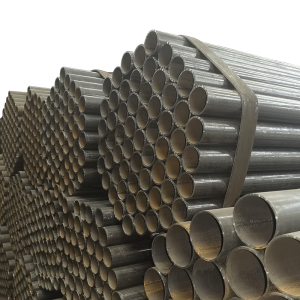
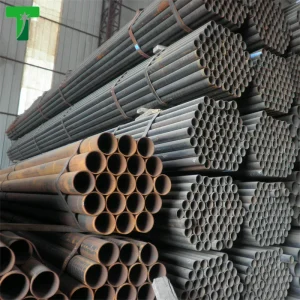
| Packaging | Steel Strip Bundles; Protective Wrapping Upon Request |
Applications
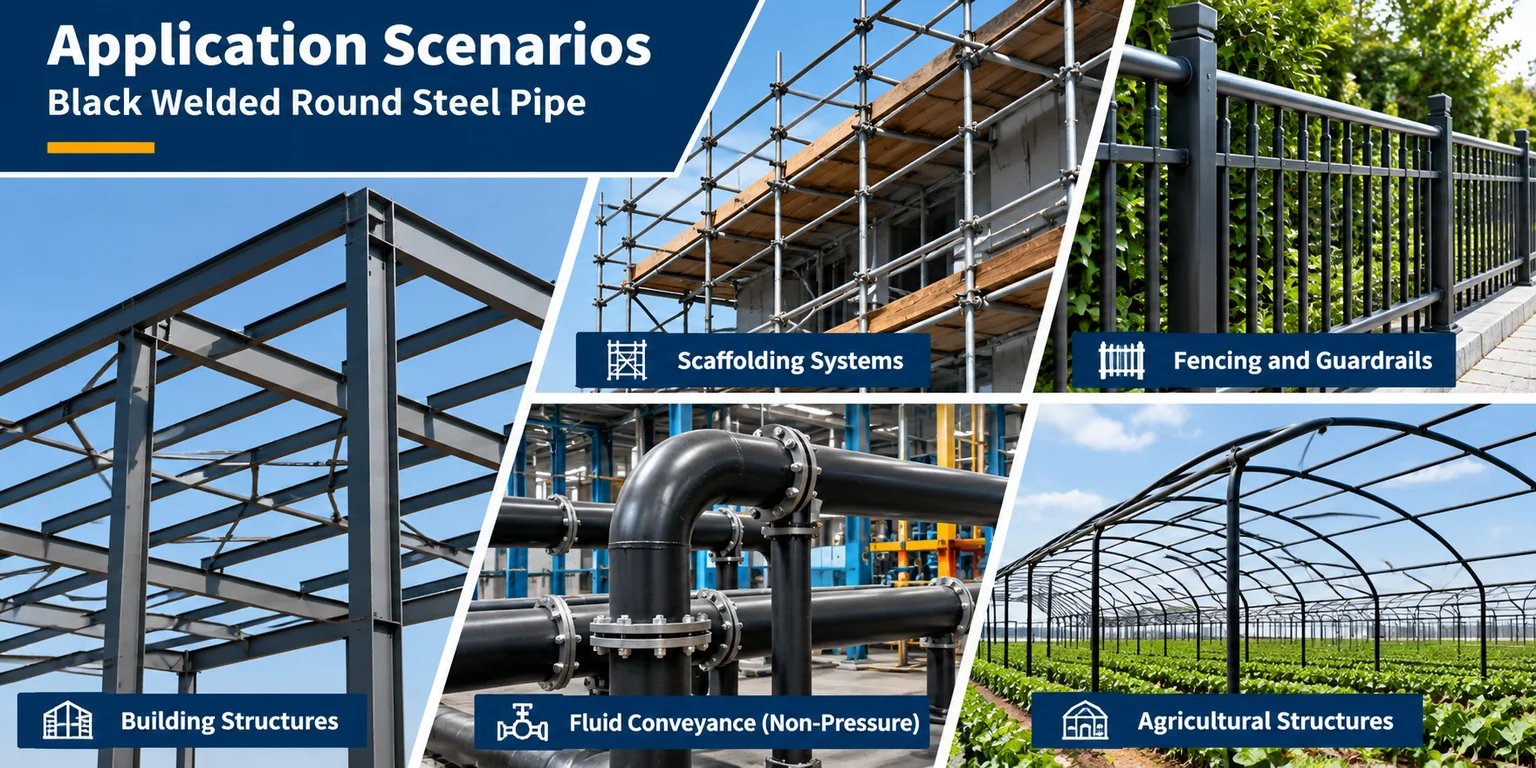
Black Welded Round Steel Pipe is widely used in projects involving tubular frameworks, fabricated components, and general-purpose piping. Its suitability depends on the required mechanical properties, installation environment, and applicable industry standards. The following applications represent common purchasing requirements across construction, industrial, and agricultural sectors.
- Building Structures:
Used in roof trusses, tubular bracing, support columns, and secondary steel frameworks. Round sections are often selected for exposed structural members and assemblies involving connections at different angles. Structural grades and connection details must meet the project design requirements. - Scaffolding Systems:
Used for scaffold tubes and related support assemblies when manufactured and certified to the required scaffolding standards. Buyers typically specify the outside diameter, wall thickness, material grade, and applicable safety requirements for their local market. - Fencing and Guardrails:
Commonly incorporated into fence posts, horizontal rails, entrance barriers, and perimeter protection systems. For outdoor installations, suitable painting or galvanizing is generally required to reduce corrosion during long-term exposure to moisture and weather. - Non-Pressure Fluid Conveyance:
Used in drainage lines and other suitable non-pressure piping installations. Pipe selection should consider the conveyed medium, joint configuration, corrosion conditions, and relevant specifications. Pressure-rated services require pipes manufactured and tested to the appropriate standards. - Agricultural Structures:
Used in greenhouse arches, agricultural shelters, irrigation equipment supports, and farm facility frameworks. For installations exposed to humidity, fertilizers, or outdoor weather, additional corrosion protection may be necessary to extend service life.
Frequently Asked Questions
1. What sizes of black welded round steel pipes are available?
Common outside diameters include 21.3, 26.9, 33.7, 42.4, 48.3, 60.3, 76.1, 88.9, 114.3, and 168.3 mm. Wall thicknesses vary by diameter and steel grade. For ASTM A53 pipe, buyers can also specify the nominal pipe size (NPS) and schedule, such as NPS 2 Schedule 40, instead of listing the outside diameter and wall thickness separately.
2. What is the minimum order quantity for black welded round steel pipes?
For reference, small stock orders in the steel trade may start around 1–3 MT, while custom production may require 5–10 MT or more per specification. These are indicative purchasing quantities, not fixed minimums for every product. Mixed-size orders can also be considered when arranging a consolidated shipment.
3. What pipe lengths are suitable for container shipping?
Common supply lengths are 5.8 m, 6 m, 11.8 m, and 12 m. The 5.8 m length is commonly selected for standard 20GP containers, while 11.8 m is generally more practical for 40GP or 40HQ loading. Full 6 m and 12 m lengths require a suitable loading arrangement. Container dimensions and loading feasibility should be checked before order confirmation.
4. Are black welded round steel pipes manufactured using the ERW process?
ERW is widely used for small- and medium-diameter longitudinal welded pipes. Larger welded pipes may be produced by other methods, including longitudinal submerged arc welding (LSAW). Buyers requiring ERW pipe should specify the manufacturing process and applicable standard in their purchase order to avoid confusion with other welded pipe types.
5. How are black welded round steel pipes packed for export?
Steel-strip bundles are the standard packing method for many commercial pipe shipments. Optional protection includes anti-rust oil, waterproof woven wrapping, and pipe-end protection. Containerized cargo is secured to limit movement during transit, while break-bulk shipments may require reinforced bundles and additional handling protection.
6. What details are required for a black welded round steel pipe quotation?
Include the outside diameter or NPS, wall thickness or schedule, steel grade, applicable standard, pipe length, quantity per size, and destination port. For projects requiring mill test certificates (MTC), specific pipe-end preparation, or additional corrosion protection, include these details in the RFQ so they can be reflected in the quotation.