Galvanized Expanded Steel Mesh
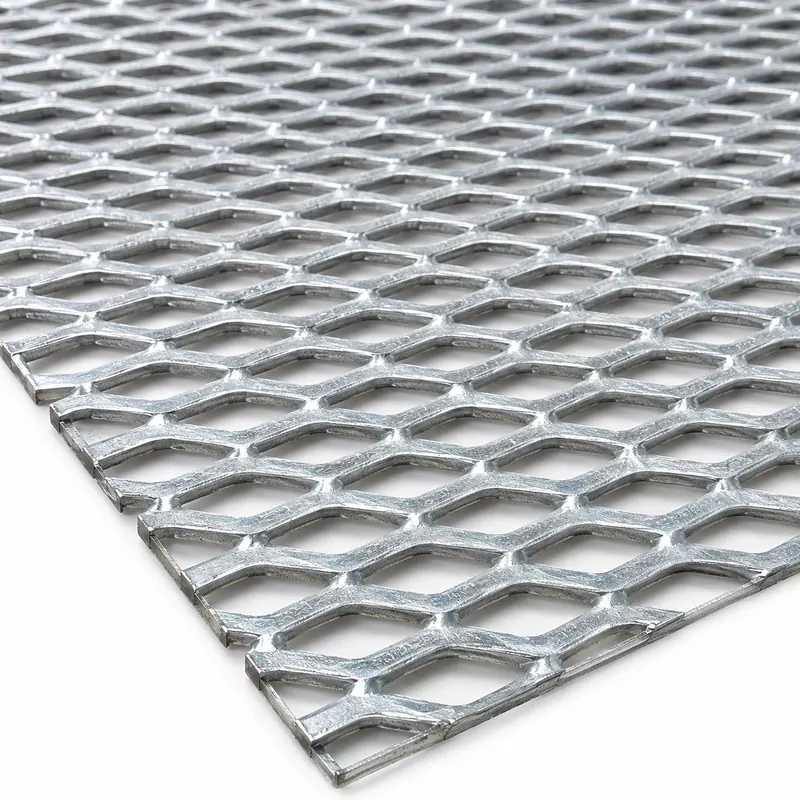
Galvanized Expanded Steel Mesh
Galvanized Expanded Steel Mesh is available in diamond patterns with various opening sizes, strand widths, and sheet thicknesses. Raised and flattened options are offered, with custom dimensions available for fencing, construction, and industrial applications.
- Mill Test Certificate Provided
- Strict Quality Inspection
- Custom Sizes Available
- On-Time Global Delivery
Galvanized Expanded Steel Mesh is manufactured through a mechanical slitting and stretching process. Unlike woven or welded wire mesh, its interconnected strands are formed directly from a single steel sheet, eliminating the need for separate wire connections.
Two galvanizing methods are commonly used. Pre-galvanized material is processed into mesh after zinc coating, leaving some cut edges exposed. Alternatively, the finished mesh can be hot-dip galvanized to coat the newly formed edges and surfaces.
For export orders, material specifications, coating requirements, manufacturing tolerances, and inspection procedures should be confirmed before production. Depending on the order requirements, suppliers may provide material certificates, dimensional inspection records, and coating test reports.
Product Features
- Open Area: Mesh openings allow air circulation, light passage, and water drainage.
- Surface Grip: Raised strands provide a textured surface for applications requiring additional traction.
- Installation Methods: Panels can be attached using bolts, clamps, or welded frames where appropriate.
- Edge Treatment: Cut edges can be trimmed, deburred, or framed to meet handling and installation requirements.
- Panel Handling: Individual sheets can be stacked and separated for easier loading and unloading.
- Export Packaging: Bundles can be secured with steel straps and pallets to reduce movement during transportation.
Technical Specifications
| Item | Available Range |
|---|---|
| Product | Galvanized Expanded Steel Mesh |
| Type | Raised / Flattened |
| Material | Q195 / Q235 Carbon Steel |
| Sheet Thickness | 0.5–6.0 mm |
| Strand Width | 0.5–8.0 mm |
| SWD (Short Way of Diamond) | 5–50 mm |
| LWD (Long Way of Diamond) | 10–100 mm |
| SWO / LWO | According to Mesh Design |
| Sheet Width | 500–1500 mm |
| Sheet Length | 1000–3000 mm |
| Mesh Pattern | Diamond |
| Surface Treatment | Pre-Galvanized / Hot-Dip Galvanized After Expansion |
| Zinc Coating | According to Coating Specification |
| Edge Processing | Trimmed / Deburred / Framed |
| Secondary Processing | Cutting / Bending / Punching / Welding |
| Application | Fencing / Walkways / Safety Guards / Ventilation Panels |
| Inspection | Dimensional / Surface / Coating Inspection |
| Packing | Steel-Strapped Bundles / Wooden Pallets |
| Customization | Mesh Openings / Strand Width / Sheet Dimensions |
Applications
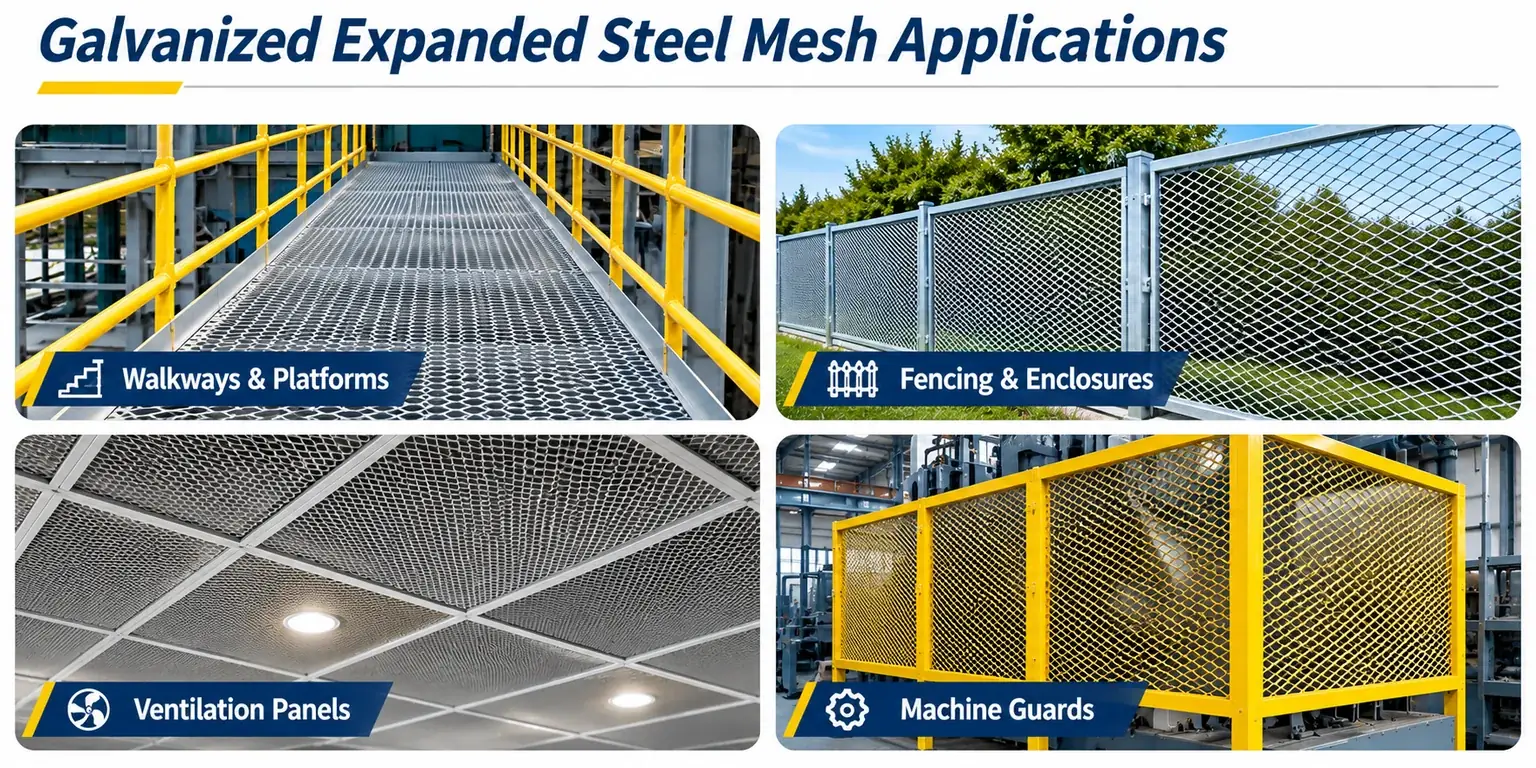
Galvanized Expanded Steel Mesh is used in industrial facilities, construction projects, and equipment manufacturing where open metal panels are required. Mesh selection depends on the installation environment, opening dimensions, support structure, and intended function. The following applications illustrate common uses of galvanized expanded metal sheets.</p >
- Walkways & Platforms:
Used for industrial access walkways, maintenance platforms, and elevated working areas. Mesh panels allow water and debris to pass through the surface. Thickness, strand dimensions, supporting spans, and load capacity must be verified for pedestrian use. - Fencing & Enclosures:
Installed in perimeter fencing, equipment enclosures, storage areas, and industrial partitions. Expanded mesh panels can be mounted within steel frames or attached to supporting posts, with opening sizes selected according to visibility and access-control requirements. - Ventilation Panels:
Used in ventilation covers, equipment housings, ceiling panels, and industrial air circulation systems. The open mesh structure permits airflow while providing a physical barrier. Opening dimensions and open-area percentage should be selected according to ventilation requirements. - Machine Guards:
Incorporated into protective barriers around industrial machinery, production equipment, and restricted operating areas. Mesh panels provide visibility into enclosed spaces while limiting access. Guard dimensions and safety distances must comply with applicable machinery safety requirements.
Frequently Asked Questions (FAQ)
1. What is the difference between galvanized expanded steel mesh and welded wire mesh?
Galvanized expanded steel mesh is formed from a single steel sheet, while welded wire mesh consists of individual wires joined at their intersections. Expanded mesh has no welded intersections and maintains a continuous metal structure. The choice depends on the required opening geometry, panel rigidity, installation method, and intended use.
2. How do I select the correct mesh size for my project?
Mesh selection should consider SWD, LWD, strand width, material thickness, and the required open-area percentage. Smaller openings may be suitable for screening and protective barriers, while larger openings can provide greater airflow and visibility. For load-bearing installations, the support span and design load must also be evaluated.
3. What is the difference between pre-galvanized and hot-dip galvanized expanded mesh?
Pre-galvanized mesh is made from zinc-coated steel sheets that are subsequently slit and expanded, which can expose steel along the cut edges. Hot-dip galvanizing after expansion coats the finished mesh, including its exposed edges. The appropriate method depends on the corrosion environment, coating specification, and project budget.
4. Can galvanized expanded steel mesh be supplied in custom sizes?
Yes, custom specifications may be available depending on manufacturing capabilities. Buyers should provide the required panel dimensions, mesh geometry, material thickness, and quantity. Special cutting, edge finishing, and fabrication requirements should be confirmed before production to ensure dimensional accuracy and suitable handling.
5. What information is required to obtain an accurate quotation?
Please provide the steel grade, sheet thickness, SWD and LWD dimensions, strand width, panel size, galvanizing requirements, and order quantity. The destination port and preferred delivery terms are also helpful. Technical drawings or reference samples can be submitted for non-standard specifications.
6. What quality documents and inspection options are available for export orders?
Depending on the manufacturer and purchase agreement, available documentation may include material certificates, dimensional inspection reports, and zinc coating test results. Third-party inspections by organizations such as SGS or Bureau Veritas can be arranged when agreed before production. Documentation requirements should be confirmed during quotation.