Galvanized Square Hollow Section
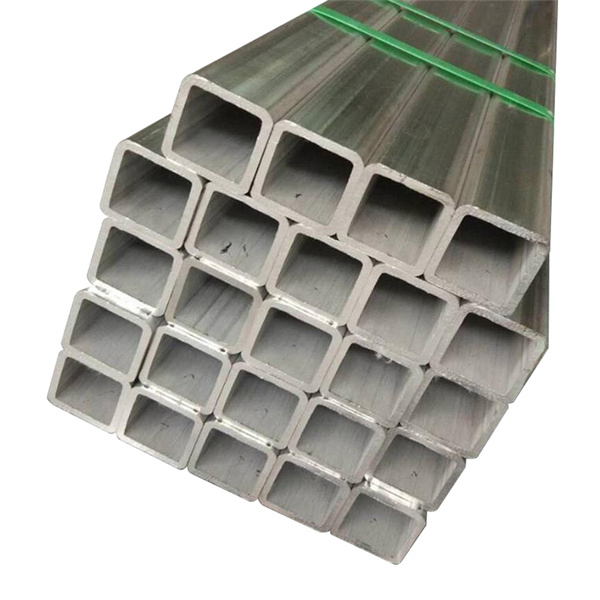
Galvanized Square Hollow Section
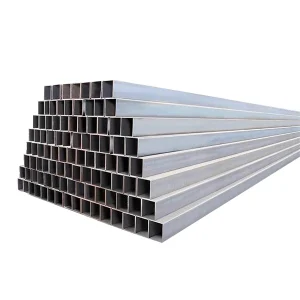
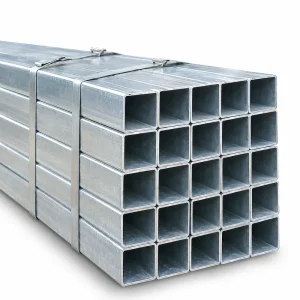
Galvanized Square Hollow Sections (SHS) are designed for structural frameworks, columns, bracing, and load-bearing applications. Their square cross-sections provide structural strength and corrosion protection, with various steel grades, dimensions, and wall thicknesses available for construction and engineering projects.
- Mill Test Certificate Provided
- Strict Quality Inspection
- Custom Sizes Available
- On-Time Global Delivery
Galvanized Square Hollow Sections (SHS) are produced through controlled steel forming and welding processes. Manufacturing requirements include weld integrity, corner geometry, straightness, and dimensional tolerances. These characteristics influence fabrication accuracy and the compatibility of structural connections.
For engineering applications, SHS products may be specified according to EN 10219 or ASTM A500/A500M, depending on project requirements. Cross-sectional area, moment of inertia, section modulus, and radius of gyration are important parameters for structural calculations. Their values depend on the selected section dimensions and applicable design assumptions. For projects requiring additional corrosion protection, galvanized steel tubing may be considered, with coating specifications defined separately from structural design requirements.
For projects using galvanized steel, SHS can be supplied in specified lengths and prepared for fabrication according to project drawings. Related galvanized steel pipe products can also be supplied with material certificates and inspection records to support procurement requirements and project traceability.
Product Features
- Symmetrical Section Properties: Square geometry provides equivalent bending properties about both principal axes, simplifying structural orientation.
- High Torsional Rigidity: The closed hollow profile provides effective resistance to twisting under torsional loads.
- Efficient Material Distribution: Steel distributed around the section perimeter supports efficient bending resistance and material utilization.
- Flexible Structural Connections: Flat surfaces accommodate welded plates, brackets, and engineered bolted connections.
- Compact Structural Geometry: Uniform external dimensions facilitate alignment and integration into space-constrained structural assemblies.
- Versatile Fabrication: Suitable for cutting, drilling, and welding, with appropriate corrosion protection after fabrication.
Product Specifications
| Parameter | Specification |
|---|---|
| Product Name | Galvanized Square Hollow Section (SHS) |
| Material | Structural Carbon Steel |
| Steel Grade | S235JRH, S275J0H, S355J2H, ASTM A500 Grade B/C, or Equivalent |
| Manufacturing Process | Cold Forming and Welding |
| Section Shape | Square Hollow Section (SHS) |
| Outside Dimensions | 20 × 20 mm – 300 × 300 mm (Reference Range) |
| Wall Thickness | 1.5 – 12.0 mm (Reference Range) |
| Standard Length | 6 m, 12 m, or Customized |
| Structural Standards | EN 10219, ASTM A500/A500M, as Applicable |
| Galvanizing Process | Hot-Dip Galvanized or Pre-Galvanized, as Specified |
| Galvanizing Standard | ISO 1461 / ASTM A123/A123M for Post-Fabrication Hot-Dip Galvanizing, as Applicable |
| Dimensional Tolerances | According to the Agreed Structural Standard |
| Corner Radius | According to Section Dimensions and Applicable Standard |
| Cross-Sectional Area (A) | Calculated According to Section Dimensions |
| Moment of Inertia (I) | Calculated According to Section Geometry |
| Section Modulus (W) | Calculated According to Section Geometry |
| Radius of Gyration (i) | Calculated According to Section Properties |
| End Finish | Plain Ends or Cut-to-Length |
| Surface Finish | Galvanized Zinc Coating |
| Inspection | Dimensional Inspection, Material Verification, Coating Inspection |
| Documentation | Material Test Certificate and Inspection Reports Upon Agreement |
| Packaging | Steel-Strapped Bundles or Customized Packaging |
Applications
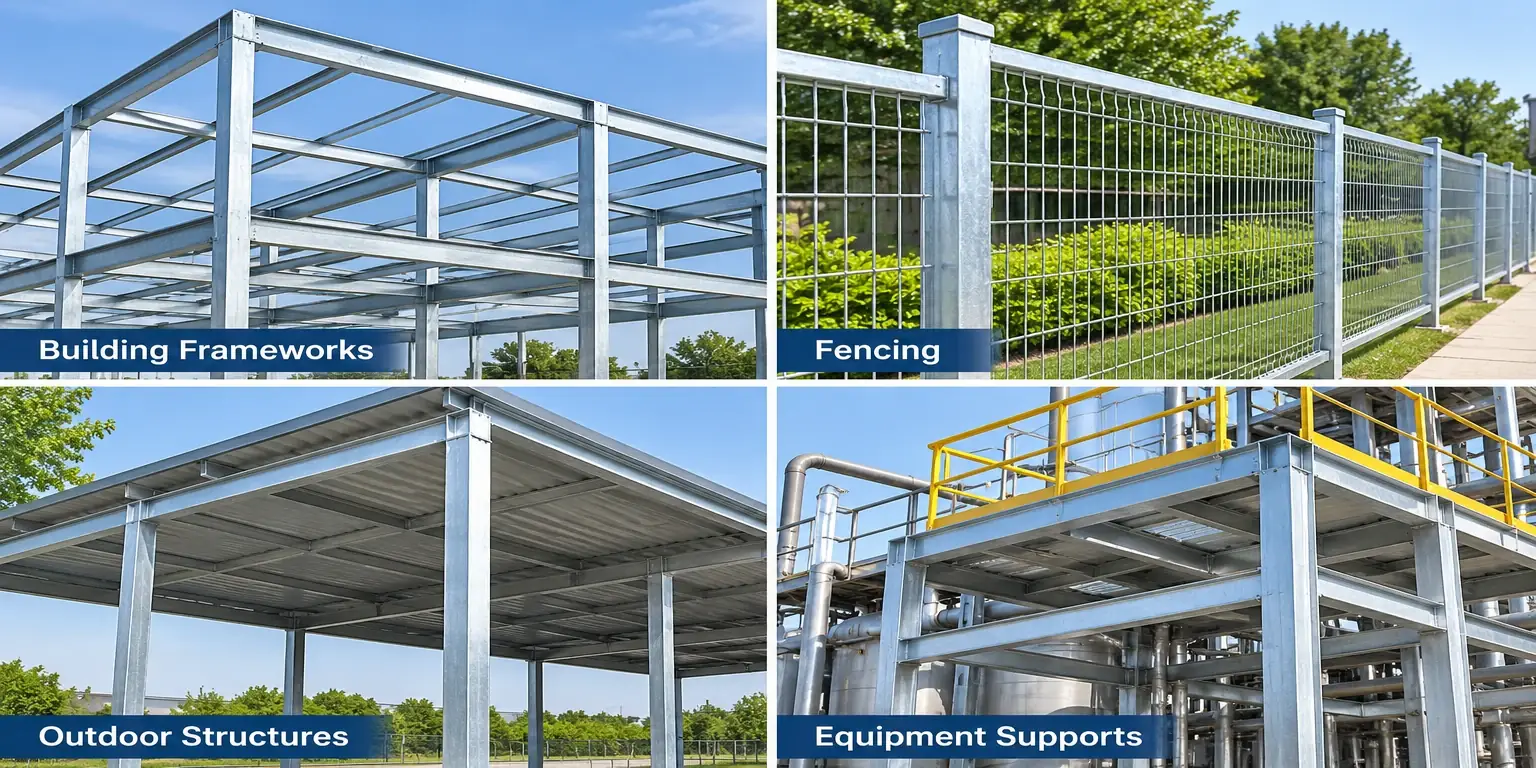
Galvanized Square Hollow Sections (SHS) are used in structural steel construction, industrial facilities, outdoor installations, and engineered support systems. Their closed square profiles provide bending and torsional resistance, while flat external surfaces facilitate structural connections. These sections can be incorporated into load-bearing frameworks and fabricated assemblies, with steel grades, section properties, and corrosion protection selected according to project design requirements.
- Building Structures:
Galvanized Square Hollow Sections are used for structural columns, secondary beams, bracing members, roof frameworks, and prefabricated building components. Their symmetrical cross-sectional geometry provides consistent bending properties about both principal axes, making them suitable for different structural arrangements. Section dimensions, wall thicknesses, steel grades, and connection details should be determined according to structural loading conditions and applicable design standards. - Canopies and Shelters:
SHS profiles are suitable for carports, entrance canopies, walkway shelters, outdoor pavilions, and covered public spaces. Their compact square geometry allows efficient integration into architectural steel frameworks while providing convenient surfaces for welded or bolted connections. Wind loads, roof loads, support spacing, and environmental exposure should be considered when selecting appropriate structural sections and galvanizing specifications. - Industrial Platforms:
Galvanized SHS members are used in equipment support frames, maintenance platforms, access structures, and industrial service installations. They can serve as columns, bracing members, and supporting framework components when designed for the required loads. Structural calculations should account for equipment weight, imposed loads, member stability, connection strength, and applicable safety requirements. - Fencing and Enclosures:
Galvanized Square Hollow Sections are used for structural fence posts, security barriers, gate frameworks, and industrial equipment enclosures. Their flat surfaces facilitate the attachment of mounting plates, brackets, and fencing components. Suitable section sizes and corrosion protection should be selected according to fence height, wind exposure, installation conditions, and the required service environment.
Frequently Asked Questions (FAQ)
1. What is the difference between SHS and RHS structural steel sections?
Square Hollow Sections (SHS) have equal outside dimensions on all four sides, while Rectangular Hollow Sections (RHS) have unequal width and height dimensions. SHS profiles provide equivalent geometric bending properties about their two principal centroidal axes, making them suitable for columns, bracing, and structural members requiring similar sectional properties in both directions. RHS profiles may be more efficient when bending loads predominantly act in one direction.
2. What standards apply to galvanized square hollow sections?
Structural SHS products may be manufactured according to EN 10219 for cold-formed welded structural hollow sections or ASTM A500/A500M for applicable structural tubing. EN 10210 covers hot-finished structural hollow sections and represents a different manufacturing category. Galvanizing requirements must be specified separately, using applicable standards such as ISO 1461 or ASTM A123/A123M for post-fabrication hot-dip galvanizing.
3. How is the load-bearing capacity of galvanized SHS determined?
The load-bearing capacity depends on steel grade, section dimensions, wall thickness, member length, support conditions, and applied loads. Engineers evaluate properties such as cross-sectional area, moment of inertia, and section modulus when checking axial compression, bending, and combined loading. Local buckling, overall member stability, and connection strength must also be considered according to the applicable structural design standard.
4. How do I select the correct SHS size and wall thickness for a structural project?
SHS selection should begin with the required loads, member span or length, support conditions, and applicable design code. Larger sections or thicker walls may improve structural resistance, but the most suitable option depends on the governing failure and serviceability criteria. Buyers should provide structural drawings, steel grade requirements, and dimensional specifications so that suitable sections can be evaluated against the project design.
5. Does galvanizing affect the structural performance of SHS?
Galvanizing primarily provides corrosion protection and is not intended to increase the structural load-bearing capacity of SHS. The steel grade, section geometry, and applicable design requirements remain the primary factors governing structural resistance. Hot-dip galvanizing can introduce thermal effects and dimensional considerations, particularly for certain fabricated assemblies. Ventilation, drainage, and fabrication details should be reviewed before galvanizing.
6. What certificates and inspection documents are available for structural SHS?
Depending on the agreed specification and production arrangements, documentation may include material test certificates, dimensional inspection reports, chemical composition results, and mechanical test records. EN 10204 Type 3.1 inspection certificates may be specified when applicable and available from the manufacturer. Galvanizing inspection reports and third-party inspection services can also be arranged subject to agreement before production.